
Stories From The Press

Celebrating 30 Years!
By Paulson Fontaine Press

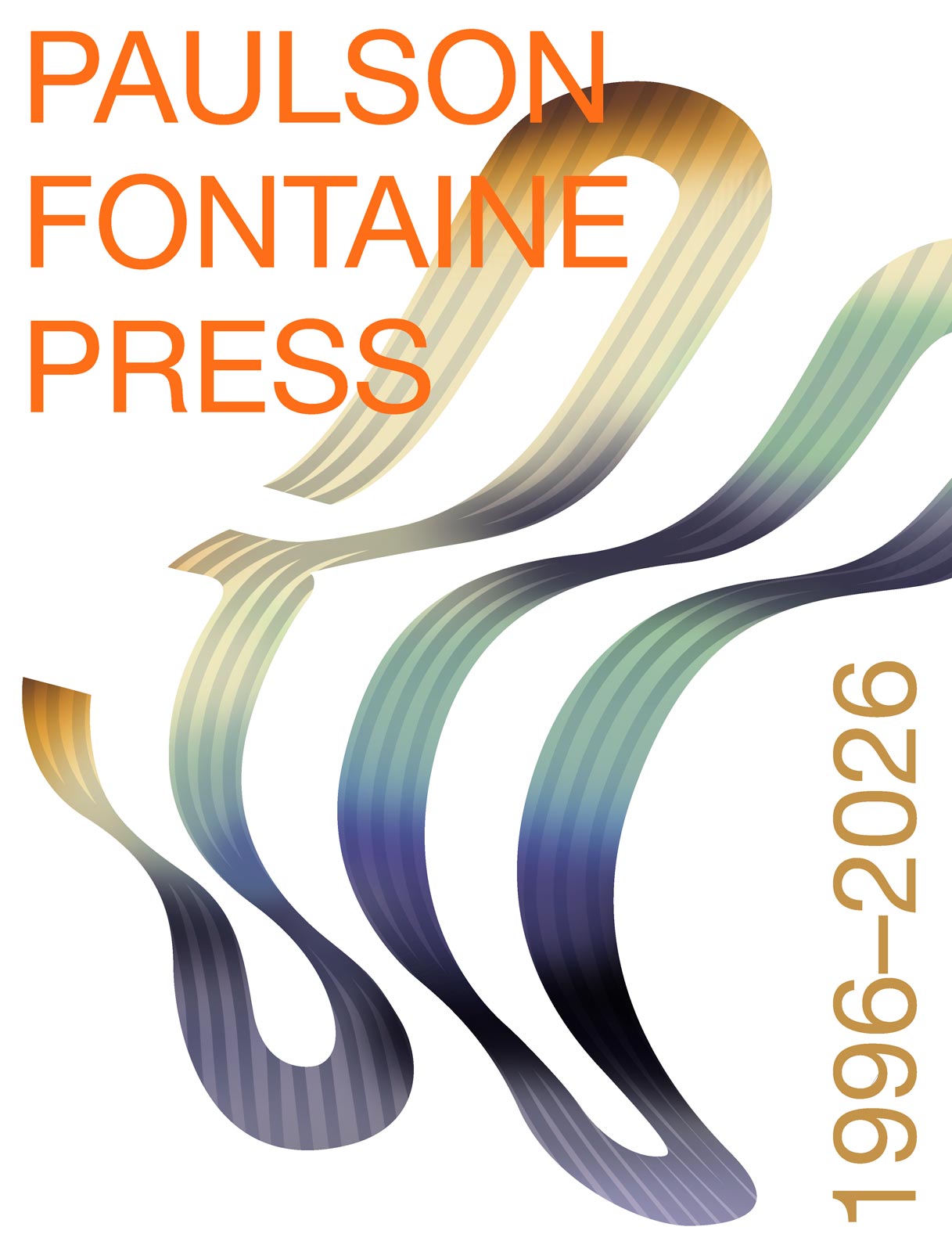
Paulson Fontaine Press Celebrating 30 Years 1996-2026

In our 1,500 square foot studio on 55th Street in Emeryville, California—on a small, borrowed, hand-crank press—we printed our first edition by Christopher Brown, aptly titled Start. Since that time, the press has established itself in Berkeley and published over 700 editions and invited over 60 artists from all over the country to make prints, many returning multiple times.

In addition to artists, we have collaborated with architects, art consultants, book binders, chefs, collectors, conservators, curators, designers, fabricators, framers, galleries, ink producers, machinists, museums, non-profits, papermakers, photogravurists, scholars, and vintners.

I’ve trained over 20 printers and a multitude of interns. Our dedicated team now includes three Master Printers, a Gallery Director, and Gallery Manager.

By account, we have used approximately 25,935 pounds of copper (1,641,600 square inches), 220 gallons of ferric acid, 9,280,833 square feet of paper, and 2,112 pounds of etching ink. We have three presses with a maximum bed size of 96″ x 52″.

For 30 years, we have maintained one purpose—to produce and publish the best intaglio etchings possible with the world’s preeminent artists. Our mission has been to steward the long history of the print atelier and to expand upon what is possible in the medium. Most importantly, we’ve strived to emphasize overlooked voices, while extending the field to larger audiences.

This endeavor requires that we continue to respect and improve our craft, challenge our own conventions-and most of all—love what we do.

Here’s to another 30 years!

In the Gallery: New Releases by Dawoud Bey and Torkwase Dyson

By Rhea Fontaine

May 1, 2026 – August 31, 2026

Paulson Fontaine Press is pleased to release five new photogravures by Dawoud Bey and two new etchings by Torkwase Dyson.

Groundbreaking American artist and MacArthur Fellow Dawoud Bey examines the Black past and present. His photographs and film installations engage the oft disappeared histories of the Black presence in America. Bey began his career as a photographer in 1975 with a series of photographs, “Harlem, U.S.A,” that were exhibited to critical acclaim in his first one-person exhibition at the Studio Museum in Harlem in 1979. His work has since been the subject of numerous major museum and gallery exhibitions throughout the United States and Europe, with works held in numerous public collections.

Torkwase Dyson describes herself as a painter working across multiple mediums to explore the continuity between ecology, infrastructure, and architecture. Dyson’s abstract works are visual and material systems used to construct fusions of surface tension, movement, scale, real and finite space. With an emphasis on the ways black and brown bodies perceive and negotiate space as information, Dyson looks to spatial liberation strategies from historical and contemporary perspectives, seeking to uncover new understandings of the potential for more livable geographies.

In the Gallery: Tip of the Hat: Etchings by Hernan Bas, Kota Ezawa, David Huffman, Kerry James Marshall & Henry Taylor

By Rhea Fontaine

March 17th – May 1st, 2026

Tip of the Hat brings together editions published by Paulson Fontaine Press that nod to influential artists and works from art history. Hernan Bas offers an updated exploration of “The Nightmare,” one of the most provocative paintings of the Romantic era, created by Henry Fuseli. Kota Ezawa recreates The Last Sitting by Bert Stern in his signature, reductive style.  David Huffman pulls trees from the backgrounds of Nicolas Poussin paintings and situates them next to his iconic basketball pyramids. Kerry James Marshall is in direct conversation with Rococo painters such as François Boucher, Jean-Honoré Fragonard, and Jean-Antoine Watteau, as he continues to create a “counter-archive” that refuses the invisibility of Black figures in Western pictorial traditions. Editions by Henry Taylor take influence from the Still Life paintings of Max Beckmann and the interiors of painter Édouard Vuillard.

In the Gallery: Hernan Bas Nightmares

By Rhea Fontaine

October 31st, 2025 – February 28th, 2026

Hernan Bas is known for his ornate figurative paintings that explore identity, sexuality, and subjectivity. Influenced by romanticism and gothic literature, Bas’s work marries the lush, introspective, and preternatural stylistic tropes of these genres with his own observations of humanity. Bas often blurs the lines between realityand fantasy, questioning the distinction between the two. His paintings present dark, often humorous narratives grounded by his masterful technical skills, immense art historical knowledge, and sharp wit. Paulson Fontaine Press is happy to announce the release of  four new, large-scale editions with Bas: Nightmare (blue); Nightmare (mood ring); Nightmare (red); Nightmare (yellow), inspired by Henry Fuseli’s 1781 painting, The Nightmare. 

In the Gallery: New Etchings: Derek Fordjour and Greg Rick

By Rhea Fontaine

July 15, 2025 – October 15, 2025

Paulson Fontaine Press is happy to present new releases by Derek Fordjour and Greg Rick.

Derek Fordjour makes paintings, sculptures, and installations in which exuberant visual materiality gives rise to portraits and other multilayered compositions. Fordjour’s tableaux are filled with athletes, performers, and others who play key roles in cultural rituals and communal rites of passage. In his paintings, Fordjour methodically constructs the ground of each composition through a collage-based process involving cardboard, newspaper, and other materials and pigments. The varied and textural surfaces that emerge are as complex—and physically engaging—as the dynamic subjects that Fordjour inscribes on top, within, and through them.

Greg Rick makes powerful paintings that delve into archetypal explorations of human nature.  His rhythmic works writhe with movement, blurring lines between history painting and abstraction. Like Guston’s pile-ups, Rick compresses gesture and form to provoke ideas of struggle, confrontation, and transcendence. While mining his personal experiences with the 101st Airborne, he joins a long tradition of artists like Picasso, Goya, and Léger who used paint to mourn the spoils of war.